
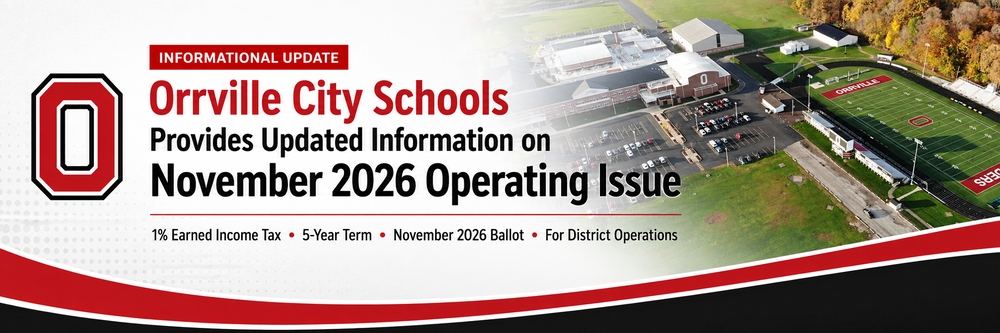
Orrville City Schools continues to provide residents with factual information about the District’s financial outlook and the 1% earned income tax issue that will appear on the November 2026 ballot.
The proposed earned income tax would be in place for five years and would provide revenue for the District’s day-to-day operating expenses. The Orrville City Schools Board of Education approved placing the issue before voters as the District addresses significant reductions in projected state and local revenue.
Residents who would like to review the District’s complete financial presentation can view it here:
VIEW THE NOVEMBER 2026 OPERATING ISSUE INFORMATION PRESENTATION
https://drive.google.com/file/d/1EW7SH9MEOOnIjHwUjvefhFXRNz1hNtNk/view?usp=sharing
Why Is the District Seeking Additional Revenue?
Orrville City Schools receives much of its General Fund revenue from a combination of state funding and locally generated tax revenue. Recent changes affecting both sources are having a significant impact on the District’s financial outlook.
Recent changes to Ohio property tax laws are projected to result in approximately $1.1 million less in local revenue annually than the District would have received under previous law.
At the same time, changes affecting the state funding formula are projected to result in approximately $1.2 million less in state funding annually. Factors affecting Orrville include enrollment, changes in local property values and income, and the state’s use of 2022 base-cost information in the funding formula.
Combined, the District projects an approximately $2.3 million annual decrease in revenue, or approximately $9.2 million over four fiscal years, compared with previous property tax law and FY2024 state funding levels.
What Is the District’s Current Financial Outlook?
Orrville City Schools closed FY2026 with an operating loss of approximately $1.47 million, requiring the District to use General Fund cash reserves to cover expenditures that exceeded revenue.
FY2027 is currently projected to result in an operating loss of approximately $2 million, although actual expenditures remain subject to change during the fiscal year. Based on current projections, General Fund cash reserves could be exhausted by the end of FY2029, which corresponds with the 2028–2029 school year.
The District has already implemented several cost-saving measures, including:
Eliminating permanent substitute teacher positions
Freezing administrator pay
Reducing staffing through attrition by not filling certain positions following retirements
Implementing food service efficiencies and other cost reductions
These measures have reduced expenditures but do not fully offset the projected reduction in recurring revenue.
What Will Be on the November Ballot?
The November 2026 ballot issue proposes the following:
1% Earned Income Tax
Five-Year Term
For District Operations
The Ohio Department of Taxation forecasts that the proposed earned income tax would generate approximately $2.57 million annually.
The District projects that this revenue would help address the operating gap while continued expenditure controls would still be necessary.
Revenue from the issue would support the District’s day-to-day operating expenses, including classroom staffing and instructional support, student services, transportation, student activities, utilities, educational materials and supplies, and other costs associated with operating the schools.
The issue is for school operations and is not for a new building project.
How Does an Earned Income Tax Work?
An earned income tax is based on income earned through employment or self-employment by residents of the Orrville City School District.
The earned income tax generally applies to:
Wages
Salaries
Tips
Self-employment income
The earned income tax does not apply to:
Retirement income
Social Security
Interest
Dividends
Capital gains
Unemployment benefits
Only residents of the Orrville City School District would pay the school district income tax.
What Happens If the Issue Does Not Pass?
If the operating issue does not pass, no specific reductions have been determined or approved by the Orrville Board of Education at this time.
However, the District would still need to address the gap between recurring revenues and operating expenditures. Based on current projections, that gap is approximately $2 million annually.
The District must operate within the financial resources available to it while continuing to meet applicable state and federal educational requirements.
Because personnel costs represent the largest portion of school district operating expenditures, a reduction of this magnitude could not realistically be addressed through supplies and other non-personnel expenses alone.
If reductions become necessary, the Board would need to evaluate major areas of District operations, which could include staffing, programs, services, course offerings, student activities, and other operating expenditures.
No decisions regarding specific reductions have been made at this time.
Any specific reductions would be developed through the District’s financial planning process and considered publicly by the Orrville Board of Education.
Learn More
Orrville City Schools will continue to provide factual information to help residents understand the District’s finances, operations, the earned income tax and the November 2026 ballot issue.
VIEW THE NOVEMBER 2026 OPERATING ISSUE INFORMATION PRESENTATION
https://drive.google.com/file/d/1EW7SH9MEOOnIjHwUjvefhFXRNz1hNtNk/view?usp=sharing
UNDERSTANDING THE NOVEMBER 2026 ORRVILLE CITY SCHOOLS OPERATING ISSUE
https://www.orrvilleschools.org/article/3005058
FREQUENTLY ASKED QUESTIONS: NOVEMBER 2026 OPERATING ISSUE
https://www.orrvilleschools.org/o/es/article/3027017
Public Information Notice
This information is provided solely to explain district finances, operations, and Board action. Orrville City Schools does not use district resources to advocate for or against the passage of a ballot issue.