
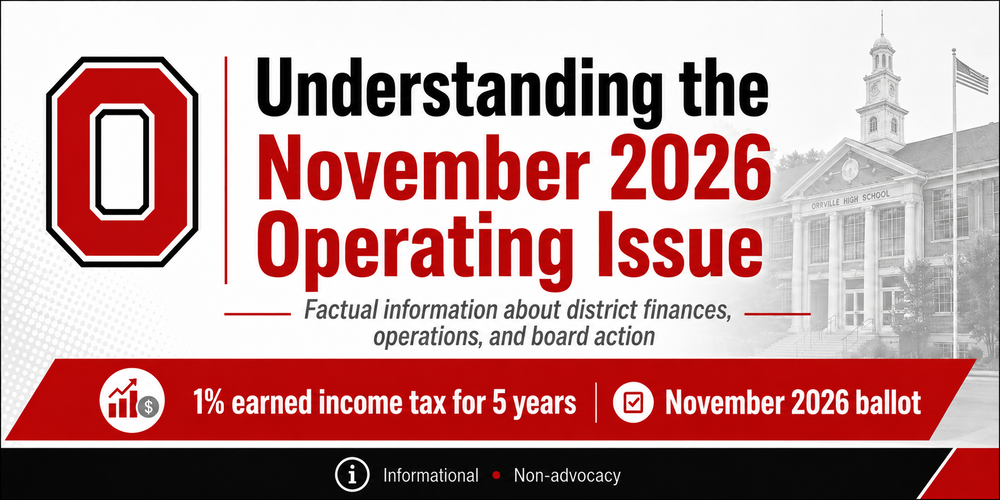
Orrville City Schools is providing the following information to help residents understand the operating issue that will appear on the November 2026 ballot.
This article explains the district’s financial circumstances, the earned income tax issue, and the cost-containment measures already taken by the district. It is intended to provide factual information and is not intended to advocate for or against the ballot issue.
## What Will Be on the Ballot?
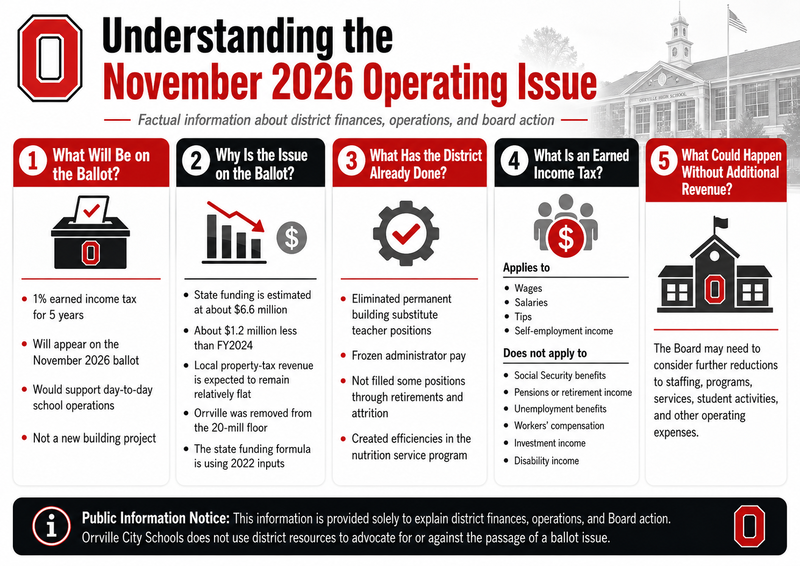
A 1% earned income tax for five years will appear on the November 2026 ballot for Orrville City Schools.
If approved by voters, the revenue generated by the earned income tax would support the district’s day-to-day operating expenses, including:
* Classroom staffing and instructional support
* Student services
* Transportation
* Student activities
* Utilities
* Educational materials and supplies
* Other costs associated with operating the district’s schools
The issue is for school operations and is not for a new building project.
## Why Is the Issue on the Ballot?
The district’s financial outlook has changed due to changes in Ohio’s school-funding system and property-tax laws.
Orrville City Schools’ state funding is estimated at $6.6 million, about $1.2 million less than the district received in fiscal year 2024.
Several factors are affecting the district’s revenue:
* Orrville was removed from Ohio’s 20-mill floor.
* The state funding formula is using financial inputs from 2022.
* Local property-tax revenue is expected to remain relatively flat.
* Increases in property values do not result in proportional increases in school revenue.
* The costs of staffing, transportation, insurance, utilities, supplies, and other school operations continue to increase.
These conditions have created a gap between the district’s recurring revenue and its recurring operating expenses.
## What Has the District Already Done to Reduce Costs?
The district has implemented several measures to contain or reduce recurring expenses, including:
* Eliminating permanent building substitute teacher positions
* Freezing administrator pay
* Not filling certain teaching and other positions following retirements or employee departures
* Reviewing staffing levels based on enrollment, class sizes, student needs, and program requirements
* Creating efficiencies within the district’s nutrition service program
These measures have reduced expenses. However, they do not fully offset the reduction in state funding and the limitations on local revenue growth.
## What Is an Earned Income Tax?
An earned income tax is based on income earned through employment or self-employment by school district residents.
The tax would generally apply to:
* Wages
* Salaries
* Tips
* Other employee compensation
* Self-employment income
The earned income tax would not apply to:
* Social Security benefits
* Pensions or retirement income
* Unemployment benefits
* Workers’ compensation
* Investment income
* Disability income
Unlike a property tax, an earned income tax is based on income earned from working rather than the value of a person’s home or property.
## What Could Happen Without Additional Revenue?
Without additional revenue, the district’s five-year financial forecast indicates that the Board may need to consider further reductions to staffing, programs, services, student activities, and other operating expenses.
Any future decisions would be made publicly by the Board after reviewing the district’s financial condition, student needs, educational priorities, and available resources.
## The Community Will Decide
The 1% earned income tax for five years will appear on the November 2026 ballot. Orrville voters will decide whether the district will receive this additional revenue to support its day-to-day operations.
Orrville City Schools will continue to provide factual information about district finances, operations, the earned income tax, and the certified ballot language.
Public Information Notice: This information is provided solely to explain district finances, operations, and Board action. Orrville City Schools does not use district resources to advocate for or against the passage of a ballot issue.